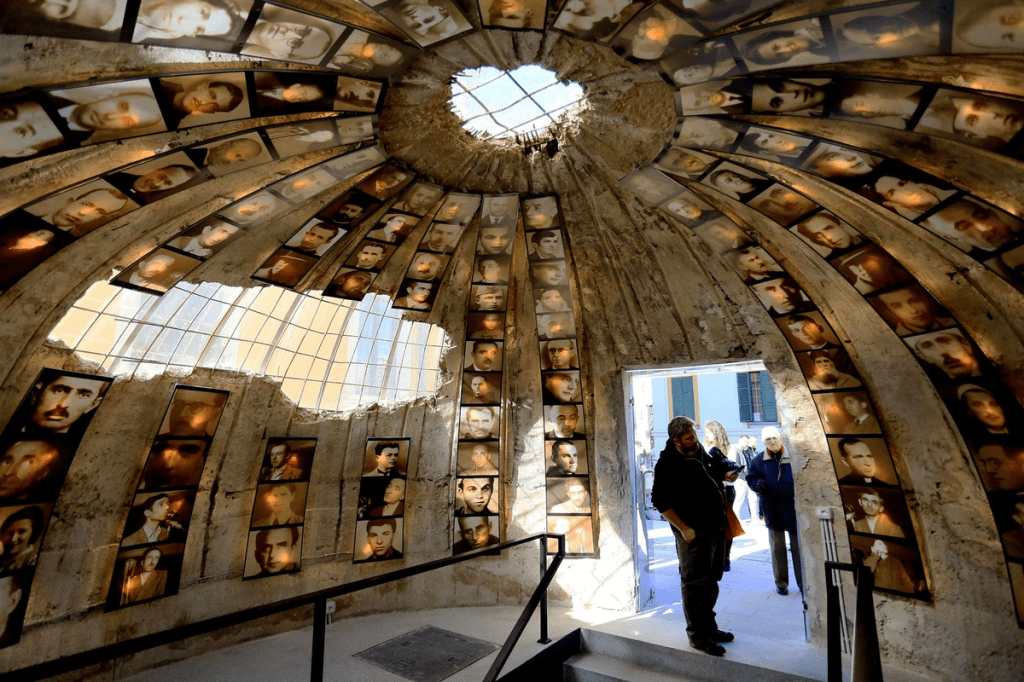
In recent years, the way states construct their international image has undergone a noticeable transformation. National image is no longer shaped passively by historical legacy or produced solely through media representation. Instead, it has become a deliberate and coordinated project involving governments, cultural institutions, and tourism sectors, aimed at reshaping national memory and influencing how societies beyond the state’s borders perceive it. Through the careful selection of historical events, the reframing of periods of struggle and suffering, and the design of tourism experiences around specific narratives, states increasingly succeed in producing new mental images that are presented internationally as authoritative representations of the past.
This study examines the relationship between curated national narratives and the psychological attachment that develops when visitors engage with the past as it is presented through these state-framed experiences. It explores how emotional engagement can be transformed into economic value through tourism, while also addressing the distinction between lived historical memory and memory that is selectively reproduced and staged. Rather than seeking to condemn or celebrate these practices, the study aims to analyze their mechanisms and implications within the broader context of international relations, and to understand how memory can shift from a historical burden into an economic resource, from a collective wound into a medium of communication and global attraction. At its core, this research is concerned with how international image is constructed and converted into an economic, cultural, and touristic asset.
Albania as a Case Study
Albania represents one of the most prominent post-communist examples in Europe of how a painful past can be mobilized to construct a new national narrative aligned with the state’s efforts to reintroduce itself to the international community. After decades of isolation, the country inherited a heavy legacy of fear and security obsession, materialized in an extensive network of underground bunkers and embedded in a collective memory shaped by surveillance and repression. Long regarded as an uncomfortable burden, this past has gradually been transformed into a symbolic and economic resource through tourism initiatives centered on what is often described as “memory tourism.”
Among the most significant of these initiatives is Bunk’Art, officially opened in 2016, following the architectural and cultural conversion of a nuclear bunker built by the communist regime beneath the capital, Tirana. This enclosed space, once a symbol of extreme isolation, has been reconfigured into a narrative environment through which the state presents a renewed account of its past. Through exhibition design, audiovisual installations, and interpretive texts, the communist period is framed as a painful chapter in Albania’s history, yet one that has come to an end and been consciously surpassed.
This process extends beyond documentation or historical explanation. It actively reconstructs the visitor’s relationship with place through an emotionally charged experience built on tension, confinement, and gradual release. As visitors move through narrow corridors, interrogation rooms, and shelter spaces, they do not merely observe history but encounter it sensorially. The experience fosters a psychological connection to the narrative being conveyed, positioning Albania as a country that has emerged , both literally and metaphorically—from underground isolation toward openness and international engagement. Over time, this emotional connection translates into economic value by reinforcing an image of a state that has confronted its past and learned to mobilize it strategically.
Despite the absence of detailed public data on visitor numbers, Bunk’Art has been identified by its administration as the most visited museum in Tirana, signaling its success as a central site of memory tourism. National indicators further show a marked increase in interest in cultural and heritage sites in recent years, with over one million visitors recorded in 2024, the majority of whom were international tourists. These figures suggest that memory-based experiences have become a key component of Albania’s contemporary tourism identity, particularly within the capital.
When compared to traditional heritage sites such as Berat Castle or the historic city of Gjirokastër. both listed as UNESCO World Heritage Sites ,Bunk’Art represents a distinct model. Rather than showcasing architectural legacy or distant historical grandeur, it presents a form of political and experiential heritage. It does not rely on narratives of national pride that may feel remote to external audiences, but instead offers a shared human experience rooted in collective trauma. This shift illustrates how states move from silence or discomfort regarding the past toward its deliberate presentation, especially when that past resonates with visitors seeking encounters that extend beyond conventional tourism.
The Albanian case reveals a complex dynamic. The state does not simply display history but reshapes it into a form that circulates internationally, producing a narrative that frames the former regime as a period of vulnerability and the present as a moment of recovery and reintegration. While this approach generates tangible economic and symbolic benefits, it also grants the state considerable authority in defining what is remembered, what is set aside, and which aspects of the past are made accessible to international audiences.
In this sense, Albania has succeeded in transforming memory from a burden into a resource, from a buried secret into a touristic experience, and from a localized story into a tool of soft communication. Yet the durability of this model remains tied to the state’s ability to treat memory as a bridge toward the future rather than as a mechanism for sanitizing the present or selectively reframing the past.
References
Nora, P. (1989). Between memory and history: Les lieux de mémoire. Representations, 26, 7–24.
Macdonald, S. (2009). Difficult heritage: Negotiating the past in public spaces. Routledge.
Light, D. (2017). Progress in dark tourism and thanatourism research. Tourism Management, 61, 275–301.
UNWTO. (2024). Tourism and cultural heritage. World Tourism Organization.
Bunk’Art Museum. (n.d.). Bunk’Art: History, exhibitions, and visitor information.
https://bunkart.al
 globalresearchnotes